identi.ca is a free and open-source social networking and blogging service based on the pump.io software, using the Activity Streams protocol. Identi.ca stopped accepting new registrations in 2013, but continues to operate alongside several other pump.io-based hosts provided by E14N which continue to accept new registrations. == Features == Identi.ca is similar to social networking sites like Facebook and Google+, allowing unlimited length status updates, rich text, and images. The Activity Streams protocol supports many kinds of activities such as games. OpenFarmGame is a prototype application for an Activity Streams-based game. Previous features from its StatusNet version such as hashtags, groups, and global search are not supported. == History == === StatusNet === The service received more than 8,000 registrations and 19,000 updates within the first 24 hours of publicly launching on July 2, 2008, and reached its 1,000,000th notice on November 4, 2008. In January 2009, identi.ca received investment funds from venture capital group Montreal Start Up. On March 30, 2009, Control Yourself (since renamed StatusNet Inc) announced that Identi.ca was to become part of a hosted microblogging service called status.net to be launched in May 2009. Status.net offers individual microblogs under a subdomain to be chosen by the customer. Identi.ca will remain a free service. All notices will be published under the Creative Commons Attribution 3.0 license by default, but paying customers will be free to choose a different license. Formerly based on StatusNet, a micro-blogging software package built on the OStatus specification (and earlier based on the OpenMicroBlogging specification), Identi.ca allowed users to send text updates (known as "notices") up to 140 characters long. While similar to Twitter in both concept and operation, Identi.ca/StatusNet provided many features not currently implemented by Twitter, including XMPP support and personal tag clouds. In addition, Identi.ca/StatusNet allowed free export and exchange of personal and "friend" data based on the FOAF standard; therefore, notices could be fed into a Twitter account or other service, and also ported in to a private system similar to Yammer. === pump.io === Developer Evan Prodromou chose to change the site to the pump.io software platform in development, because pump.io offers more features making it technically more advanced. Registration on Identi.ca was closed in December 2012 in preparation for the switch to pump.io software (the popularity of Identi.ca and "official" Status.net hosting were considered a hindrance to the creation of a federated social network). The conversion was completed on 12 July 2013. The 140 character per post limit was removed (in StatusNet, it was a setting, not an inherent limitation); now the blog posts can contain formatting and images. Groups, hashtags, and a page listing popular posts are not yet implemented in pump.io.
Shader lamps
Shader lamps is a computer graphic technique used to change the appearance of physical objects. The still or moving objects are illuminated, using one or more video projectors, by static or animated texture or video stream. The method was invented at University of North Carolina at Chapel Hill by Ramesh Raskar, Greg Welch, Kok-lim Low and Deepak Bandyopadhyay in 1999 [1] as a follow on to Spatial Augmented Reality [2] also invented at University of North Carolina at Chapel Hill in 1998 by Ramesh Raskar, Greg Welch and Henry Fuchs. A 3D graphic rendering software is typically used to compute the deformation caused by the non perpendicular, non-planar or even complex projection surface. Complex objects (or aggregation of multiple simple objects) create self shadows that must be compensated by using several projectors. The objects are typically replaced by neutral color ones, the projection giving all its visual properties, thus the name shader lamps. The technique can be used to create a sense of invisibility, by rendering transparency. The object is illuminated not by a replacement of its own visual properties, but by the corresponding visual surface placed behind the object as seen from an arbitrary viewing point.
Imieliński–Lipski algebra
In database theory, Imieliński–Lipski algebra is an extension of relational algebra onto tables with different types of null values. It is used to operate on relations with incomplete information. Imieliński–Lipski algebras are defined to satisfy precise conditions for semantically meaningful extension of the usual relational operators, such as projection, selection, union, and join, from operators on relations to operators on relations with various kinds of "null values". These conditions require that the system be safe in the sense that no incorrect conclusion is derivable by using a specified subset F of the relational operators; and that it be complete in the sense that all valid conclusions expressible by relational expressions using operators in F are in fact derivable in this system. For example, it is well known that the three-valued logic approach to deal with null values, supported treatment of nulls values by SQL is not complete, see Ullman book. To show this, let T be: Take SQL query Q SQL query Q will return empty set (no results) under 3-valued semantics currently adopted by all variants of SQL. This is the case because in SQL, NULL is never equal to any constant – in this case, neither to “Spring” nor “Fall” nor “Winter” (if there is Winter semester in this school). NULL='Spring' will evaluate to MAYBE and so will NULL='Fall'. The disjunction MAYBE OR MAYBE evaluates to MAYBE (not TRUE). Thus Igor will not be part of the answer (and of course neither will Rohit). But Igor should be returned as the answer. Indeed, regardless what semester Igor took the Networks class (no matter what was the unknown value of NULL), the selection condition will be true. This “Igor” will be missed by SQL and the SQL answer would be incomplete according to completeness requirements specified in Tomasz Imieliński, Witold Lipski, 'Incomplete Information in Relational Databases'. It is also argued there that 3-valued logic (TRUE, FALSE, MAYBE) can never provide guarantee of complete answer for tables with incomplete information. Three algebras which satisfy conditions of safety and completeness are defined as Imielinski–Lipski algebras: the Codd-Tables algebra, the V-tables algebra and the Conditional tables (C-tables) algebra. == Codd-tables algebra == Codd-tables algebra is based on the usual Codd's single NULL values. The table T above is an example of Codd-table. Codd-table algebra supports projection and positive selections only. It is also demonstrated in [IL84 that it is not possible to correctly extend more relational operators over Codd-Tables. For example, such basic operation as join is not extendable over Codd-tables. It is not possible to define selections with Boolean conditions involving negation and preserve completeness. For example, queries like the above query Q cannot be supported. In order to be able to extend more relational operators, more expressive form of null value representation is needed in tables which are called V-table. == V-tables algebra == V-tables algebra is based on many different ("marked") null values or variables allowed to appear in a table. V-tables allow to show that a value may be unknown but the same for different tuples. For example, in the table below Gaurav and Igor order the same (but unknown) beer in two unknown bars (which may, or may not be different – but remain unknown). Gaurav and Jane frequent the same unknown bar (Y1). Thus, instead one NULL value, we use indexed variables, or Skolem constants . V-tables algebra is shown to correctly support projection, positive selection (with no negation occurring in the selection condition), union, and renaming of attributes, which allows for processing arbitrary conjunctive queries. A very desirable property enjoyed by the V-table algebra is that all relational operators on tables are performed in exactly the same way as in the case of the usual relations. === Conditional tables (c-tables) algebra === Example of conditional table (c-table) is shown below. It has additional column “con” which is a Boolean condition involving variables, null values – same as in V-tables. over the following table c-table Conditional tables algebra, mainly of theoretical interest, supports projection, selection, union, join, and renaming. Under closed-world assumption, it can also handle the operator of difference, thus it can support all relational operators. == History == Imieliński–Lipski algebras were introduced by Tomasz Imieliński and Witold Lipski Jr. in Incomplete Information in Relational Databases.
Radioplayer
Radioplayer is a radio technology platform, owned by UK radio broadcasters and operated under licence in some other countries. It operates an internet radio web tuner, a set of mobile phone apps, an in-car adaptor, and a growing range of integrations with other connected devices and platforms. Radioplayer is operated by UK Radioplayer Ltd which is a not-for-profit organisation owned by UK radio broadcasters. Initial shareholders were the BBC, Global Radio, GMG Radio, Absolute Radio and RadioCentre. After consolidation in the radio market, current shareholders are the BBC, Global Radio, Bauer Media Group and RadioCentre. == History == Launched in the UK on 31 March 2011, Radioplayer set out to offer a simple and accessible way to listen to radio via the internet. It contained 157 stations at launch. Initially working internally at the BBC for Tim Davie, then Director of BBC Audio & Music, Michael Hill led the project since March 2009; he was made Managing Director of UK Radioplayer Ltd on 28 July 2010. At launch, Radioplayer was a simple and straightforward Flash-based radio player, linked-to by radio stations on their own website. The player included searching and bookmarking across all of UK radio station content. On 5 October 2012, Radioplayer launched a mobile app on iOS phones with an Android version following shortly afterwards. The apps are unavailable for download outside the United Kingdom. This was followed by a tablet app on 25 September 2013. The apps also support Android Wear, Android Auto, Smart Device Link, Apple Watch and Apple CarPlay. They are also compatible with Chromecast and Airplay. In September 2016, Radioplayer announced it had been chosen by Amazon to integrate with their new voice-controlled 'Echo' device, ahead of its UK launch. In July 2017, Radioplayer integrated with the Sonos and Bose multi-room speaker platforms. UK Radioplayer currently contains around 500 UK stations, from Ofcom-licensed broadcasters. Online-only 'sister-stations' can also be added, but only by broadcasters with Ofcom licences which have been on the platform for over a year. == Radioplayer Car == Radioplayer Car was announced in September 2014 as a hybrid radio receiver that switches between FM, DAB and streaming to find the strongest signal. Speaking in Oslo in June 2015, Michael Hill said that he hoped to launch the product in the UK and Norway during the summer of 2015. In February 2017, Radioplayer Car was launched. It was marketed as the world’s first voice-controlled hybrid radio adaptor for car stereos. A small box, fitted behind the dashboard, links to the auxiliary input on an existing car radio. It connects wirelessly via Bluetooth to the driver’s smartphone by an app. The adaptor enabled drivers to listen to their own smartphone music collections using Bluetooth, take hands-free calls, listen to inbound text messages and receive instant audio travel news, customised by GPS to their location and direction of travel. The hardware was manufactured under licence by car audio interfaces supplier Connects2, and Hyde Park Corner was promoted as the preferred installer of the audio equipment. There were several spin-off benefits of the Radioplayer Car project, including the creation of the hybrid radio metadata API for cars, known as the 'WRAPI' (Worldwide Radioplayer API). == International == Through a separate company called Radioplayer Worldwide, Radioplayer technology is licensed to a number of different territories.
Pray.com
Pray.com is a Christian social networking service and mobile application designed to facilitate religious communities. Launched in 2016, it was founded by Steve Gatena, Michael Lynn, Ryan Beck and Matthew Potter. The platform offers features for social networking, daily prayers, sermons, biblical content, and podcasts. The COVID-19 pandemic significantly increased Pray.com's user base, with downloads surging by 955%. During this period, the platform collaborated with churches to support virtual ministry services as in-person gatherings were restricted. The Federal Election Commission issued an opinion in 2021 that allows the platform to feature members of the United States Congress. Pray.com serves as a specialized social media platform for religious groups. Congregations can establish their own groups where members and leaders can participate in discussions, livestream services, and manage donations. Additionally, users can join "prayer communities" to post and respond to prayer requests. For those who subscribe to premium services, the platform provides access to biblically-inspired meditations and bedtime stories, and Bible stories for children. Pray.com also produces Radio drama-style productions with notable actors such as Kristen Bell and Blair Underwood narrating biblical stories. == History == === Funding and development === Pray.com has secured significant funding to support its development and growth. In 2017, the platform raised $2 million in seed funding from Science Inc., Greylock Partners, and Spark Capital. This was followed by a Series A funding round in March 2018, in which the company secured an additional $14 million from TPG Growth, Science Inc., and Greylock Partners. Founder Steve Gatena has highlighted difficulties in securing funding, noting some venture capitalists' negative attitudes towards faith-based technology. === Clinical studies === There have been clinical studies on Pray.com. In one study, the app was found to be acceptable and easy to use among racial and ethnic minority groups, with participants reporting improved mental health and well-being. Greater app use was associated with better outcomes, though low and variable usage suggests the need for further research to fully understand its impact. Another study examined Pray.com's impact on mental health by assigning 192 participants to use the app freely, use its meditative prayer function, or not use it at all. Over two months, participants reported overall improvements in mental health and well-being. Although no significant differences were found between groups, greater app usage correlated with better mental health outcomes. This suggests that religiously based mobile apps may help improve mental health and well-being. Another study of pray.com had similar findings. === National Day of Prayer === Pray first hosted a National Day of Prayer event in 2020 when it streamed to nearly one million viewers on Facebook. In 2021, Pray hosted a virtual event for the National Day of Prayer in the United States. The event featured remarks from public figures including United States President Joe Biden and former Vice President Mike Pence. President Biden spoke of his faith and prayed for an end to the COVID-19 pandemic. Biden remarked: "It means the world to me to know that there are people across the country who include Jill and me in their prayers. And I hope you know that you and your families are in our prayers as well. Today I am praying for the end of this great COVID crisis." The event featured musical performances from Gary Valenciano, Brooke Ligertwood from the Christian band Hillsong Worship, Lecrae, Heather Headley and Michael Neale. Other notable speakers included Ronnie Floyd, Ed Young, Mark Driscoll, and Samuel Rodriguez. Pray.com partnered with Sirius XM, DirecTV and Facebook to stream the event across multiple platforms. Pray.com was featured as a pop-up channel on Sirius XM, channel 154, to host the prayer event and celebrate people of all faith. === Partnerships and sponsorships === In 2024, Pray.com partnered with Sting Ray Robb as the primary sponsor for his No. 41 Chevrolet in the 2024 NTT IndyCar Series. The partnership, highlighting Robb's Christian faith, aims to engage younger audiences with faith-based content. The car, featuring Pray.com's branding, was set to debut at the Firestone Grand Prix of St. Petersburg. A partnership with Palantir Technologies for use of its AI systems was also announced in 2024. === Censorship in China === The app was removed from Apple's App Store in China as part of the country's broader efforts to restrict access to religious content. The app was targeted due to China's stringent regulations on religious material, particularly content distributed through digital platforms. The removal aligns with China's ongoing campaign to control online religious expression and maintain state-approved religious activities.
AUTINDEX
AUTINDEX is a commercial text mining software package based on sophisticated linguistics. AUTINDEX, resulting from research in information extraction, is a product of the Institute of Applied Information Sciences (IAI) which is a non-profit institute that has been researching and developing language technology since its foundation in 1985. IAI is an institute affiliated to Saarland University in Saarbrücken, Germany. AUTINDEX is the result of a number of research projects funded by the EU (Project BINDEX), by Deutsche Forschungsgemeinschaft and the German Ministry for Economy. Amongst the latter there are the projects LinSearch, and WISSMER, see also the reference to IAI-Website. The basic functionality of AUTINDEX is the extraction of key words from a document to represent the semantics of the document. Ideally the system is integrated with a thesaurus that defines the standardised terms to be used for key word assignment. AUTINDEX is used in library applications (e.g. integrated in dandelon.com) as well as in high quality (expert) information systems, and in document management and content management environments. Together with AUTINDEX a number of additional software comes along such as an integration with Apache Solr / Lucene to provide a complete information retrieval environment, a classification and categorisation system on the basis of a machine learning software that assigns domains to the document, and a system for searching with semantically similar terms that are collected in so called tag clouds.
Joint constraints
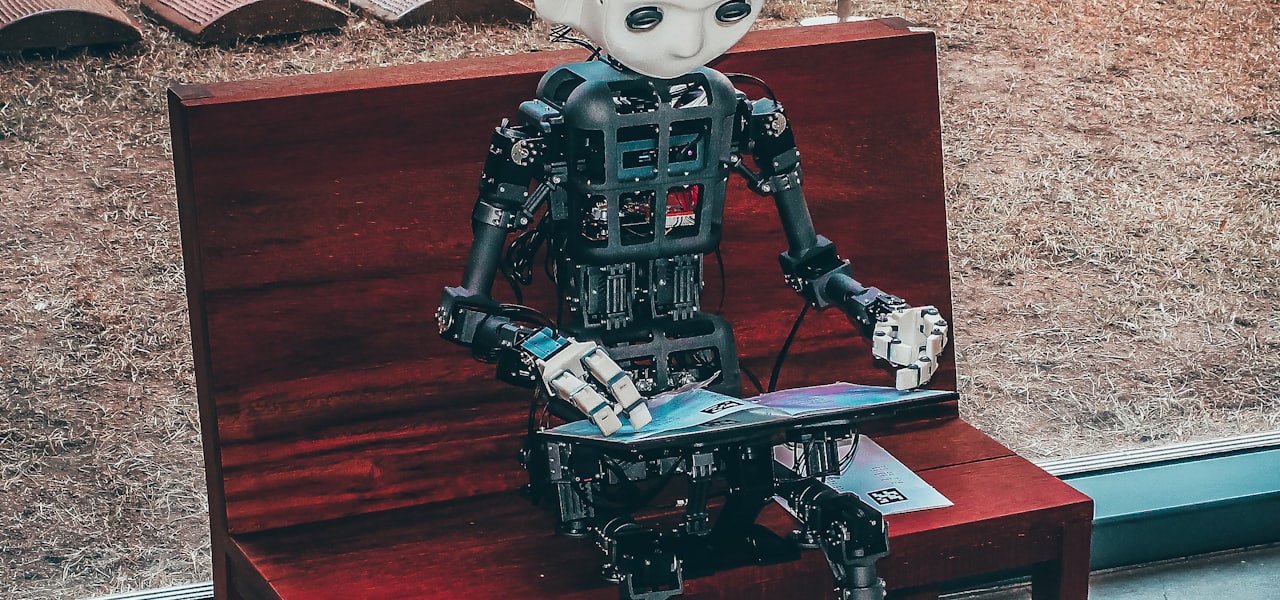
Joint constraints are rotational constraints on the joints of an artificial system. They are used in an inverse kinematics chain, in fields including 3D animation or robotics. Joint constraints can be implemented in a number of ways, but the most common method is to limit rotation about the X, Y and Z axis independently. An elbow, for instance, could be represented by limiting rotation on X and Z axis to 0 degrees, and constraining the Y-axis rotation to 130 degrees. To simulate joint constraints more accurately, dot-products can be used with an independent axis to repulse the child bones orientation from the unreachable axis. Limiting the orientation of the child bone to a border of vectors tangent to the surface of the joint, repulsing the child bone away from the border, can also be useful in the precise restriction of shoulder movement.